What are the advantages of chain-type electric hoists compared to wire rope electric hoists?
1. Lightweight structure, more flexible for installation/movement, suitable for confined spaces
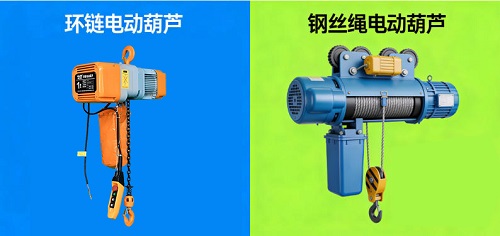
The chain hoist uses alloy steel chains as load-bearing components, featuring a lightweight and compact design that eliminates the need for heavy installation foundations. Paired with manual or lightweight electric trolleys, it enables effortless lateral movement along tracks. When temporarily relocating work positions, disassembly, transportation, and reassembly are all straightforward. In contrast, wire rope hoists, constrained by drum structures, are bulky and heavy, suitable only for fixed installations and ill-suited for confined spaces or temporary operations.
2. High operational precision, ensuring delicate lifting without bumps or impacts, suitable for handling valuable/precision components
The chain hoist comes standard with a dual-speed adjustment function, featuring a slow speed as low as 0.1-0.3m/min, enabling precise control over the lifting and lowering positions of heavy loads with smooth start-stop operation and no shaking. In contrast, the wire rope hoist has a relatively faster lifting speed and lower positioning accuracy, making it prone to load sway, and is only suitable for rough handling of large items, unsuitable for precise lifting operations.
3. Maintenance is extremely simple, with few wear-prone parts, resulting in low ongoing costs and quick learning curve
The core wear-prone component of a chain hoist is only the chain itself, requiring only regular application of specialized lubricant and inspection for deformation or chain skipping in daily maintenance, with no complex structures like drums or rope guides. In contrast, wire rope hoists necessitate periodic checks for broken wires, loose strands, or misalignment of the rope, along with drum and rope guide calibration. Gearboxes and bearings require regular oil changes, featuring numerous wear-prone parts and intricate maintenance procedures.
4. Low operating noise, suitable for indoor quiet / clean working environments
The transmission structure of the chain hoist is more compact, with smooth meshing operation between the chain and sprocket, and a working noise level of ≤65dB, approaching the volume of indoor daily conversation. In contrast, the wire rope hoist generates operational noise ≥75dB due to drum rotation and wire rope friction, making it unsuitable for quiet environments.
5. No risk of rope detachment, ensuring more stable operational safety (anti-fall / anti-deviation)
The alloy steel chain of the ring chain hoist features a closed-loop structure, paired with a anti-jump sprocket, ensuring precise meshing between the chain and sprocket during operation. This completely eliminates common issues like rope detachment, slack strands, and jamming found in wire rope hoists. Even under frequent start-stop cycles and minor oscillations, it guarantees stable load-bearing performance.
7. Strong environmental adaptability, rust-resistant and easy to maintain, stress-free for short-term outdoor use
The alloy steel chains of the chain hoist undergo quenching and galvanization treatment, offering excellent rust and corrosion resistance. Even in humid workshop environments or short-term outdoor operations (such as temporary lifting in rainy conditions), no additional complex rust-proof measures are required. In contrast, the steel wire ropes of the wire rope hoist, despite being oiled, are prone to rust when exposed to prolonged damp or dusty conditions, necessitating frequent application of rust-proof oil and more cumbersome maintenance.